
GHK-Cu: the copper peptide under the scientific lens (Research Guide 2026)
What the evidence says about GHK-Cu: collagen synthesis, matrix remodeling, gene expression profiles, human skin trials, and its regulatory status in 2026.
For research use only
The products and information on this page are intended exclusively for in vitro laboratory research and educational purposes. Not suitable for human consumption, diagnosis or therapeutic use. Studies cited are from third-party scientific literature and do not constitute medical advice.
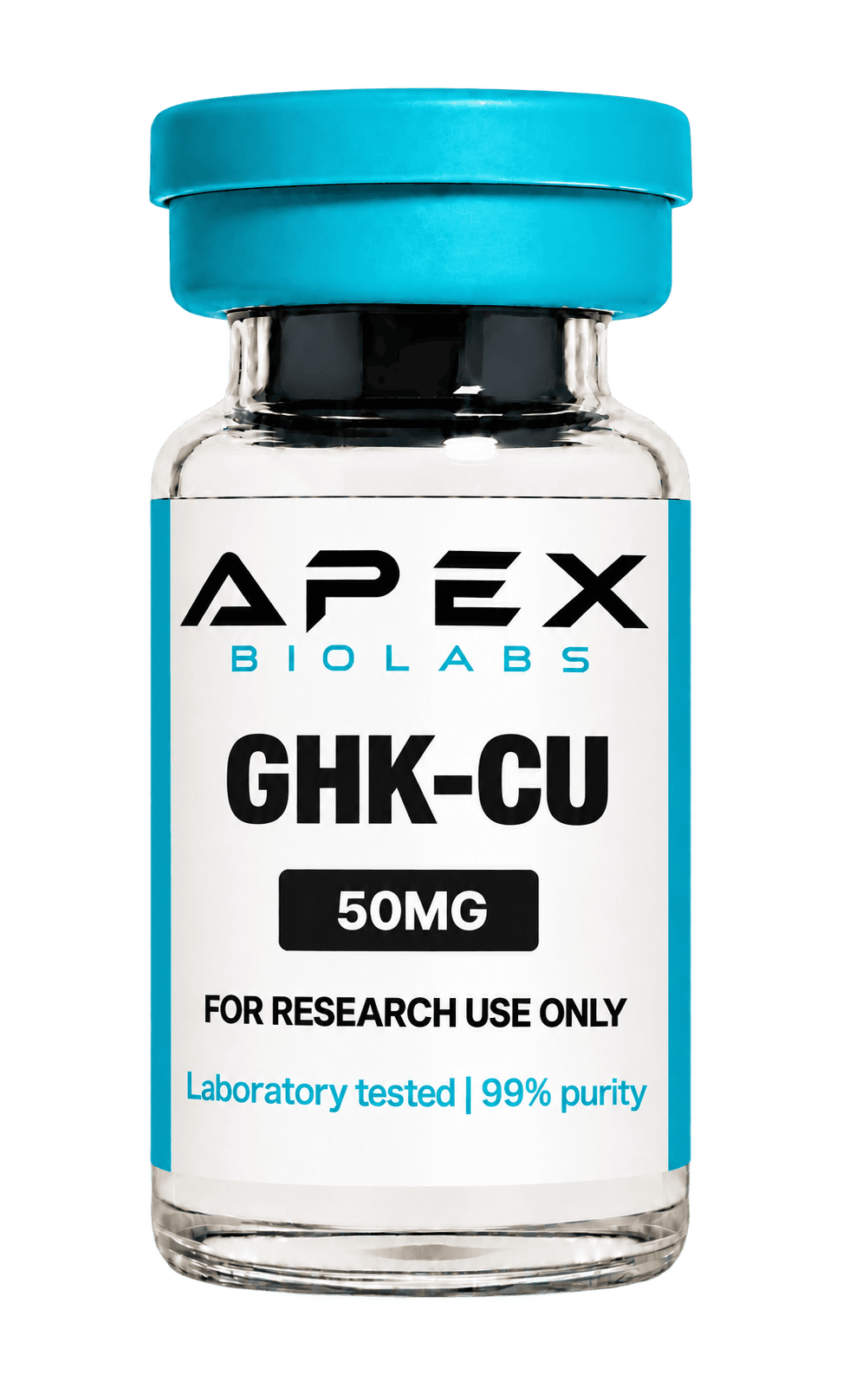
Research material
View GHK-CU
€29.98
Quick summary
- What it is: a natural tripeptide (glycine-histidine-lysine) bound to a copper ion. It is present in human plasma, saliva, and urine.
- Where the evidence is strongest: fibroblast cultures and animal wound models, with results on collagen, glycosaminoglycans, and tissue remodeling.
- In humans: several small trials with facial creams and serums, with positive but modest results that have been poorly replicated. No trials with systemic administration exist.
- Regulatory status (October 2026): widely used as a topical cosmetic ingredient. In injectable form it is not approved as a medicine in any country.
What is GHK-Cu?
GHK are the initials of its three amino acids: Glycine, Histidine, and Lysine (K in single-letter code). It is one of the smallest peptides with studied biological activity: just three links.
Its key characteristic is a very high affinity for copper (Cu²⁺), with which it spontaneously forms a complex: GHK-Cu. In cosmetics it appears on labels under the INCI name copper tripeptide-1.
A curious discovery
GHK was isolated in 1973 by biochemist Loren Pickart. He was investigating why liver tissue from older people produced proteins differently than that from younger people, and observed that a fraction of young plasma albumin caused aging liver cells to behave more like young ones. That activity turned out to be this tripeptide.
It decreases with age
According to data gathered in Pickart's reviews, GHK concentration in plasma is around 200 ng/mL at age 20 and drops to about 80 ng/mL at age 60. This is a striking finding, but should be read carefully: the fact that a compound decreases with age does not prove that this decline causes aging, nor that replenishing it reverses it. A subsequent review on its anti-aging potential states this explicitly: there are still no studies linking low GHK levels to specific aging processes or diseases.
A possible origin in collagen itself
An interesting detail: the GHK sequence appears within the α2 chain of type I collagen. Some authors therefore propose that the tripeptide could be released when enzymes degrade collagen in a wound, acting as a local signal of "repair needed here." It is an elegant hypothesis, but remains just a hypothesis.
Important context before reading the evidence
Much of the GHK-Cu literature comes from its own discoverer and his collaborators, who also developed commercial products with copper peptides. This does not invalidate the results, but it does justify giving greater weight to work from independent groups, which we note in this article where they exist.
In GHK-Cu's favor, the group of François-Xavier Maquart (University of Reims, France) published their own series of studies during the 1990s and 2000s that confirmed several effects on the extracellular matrix.
Studied mechanisms
1. Collagen synthesis
The foundational study is Maquart et al. (1988): in fibroblast cultures, GHK-Cu stimulated collagen synthesis at extremely low concentrations (in the picomolar to nanomolar range), with a maximum around 1 nM. The effect was not due to more cells, but to each cell producing more collagen.
2. Glycosaminoglycans: a bell-shaped effect
Wegrowski et al. (1992) observed that GHK-Cu increased the synthesis of glycosaminoglycans (matrix components that retain water and provide tissue support), especially dermatan sulfate and heparan sulfate, but not hyaluronic acid.
The most interesting finding: the response was biphasic. The maximum effect appeared at low concentrations and, as the concentration was raised, synthesis returned to control levels. A reminder that in biology "more" does not always mean "more effect."
3. Remodeling: building and also clearing
Repairing tissue is not only about making new collagen; damaged collagen must also be removed. Simeon et al. (2000) showed that GHK-Cu increased MMP-2 (a matrix-degrading enzyme) and its natural inhibitors TIMP-1 and TIMP-2 in fibroblasts — appearing to favor a balance between degradation and synthesis.
A very relevant detail from that study: the MMP-2 increase was reproduced by copper ions alone, but not by GHK peptide without copper. This suggests that at least some effects may be due to the copper the peptide transports into cells.
4. Gene expression profiles
In 2012, a team from Boston University (Campbell et al.), independent of Pickart's group, analyzed gene expression in lung tissue from COPD and emphysema patients. Using the Broad Institute's Connectivity Map database, they searched for compounds whose gene effects were the opposite of emphysematous damage, and GHK appeared among the candidates. They then tested it in fibroblasts from COPD lungs and observed it helped restore their ability to contract and remodel collagen.
From this data, Pickart and collaborators published analyses attributing changes in thousands of genes to GHK. The scope is important: these are expression data in cultured cell lines, useful for generating hypotheses, not proof of effects in a living organism.
Key studies in animal and cellular models
| Study | Model | What was measured | What was found |
|---|---|---|---|
| Maquart et al., 1988 | Fibroblasts in culture | Collagen synthesis | Increase at very low concentrations, no change in cell number |
| Wegrowski et al., 1992 | Normal human fibroblasts | Glycosaminoglycans | Increase with biphasic curve: effect disappears at high concentrations |
| Maquart et al., 1993 | Wound chambers implanted under rat skin | Collagen, proteins, DNA, mRNA | More matrix accumulation. Collagen doubled vs other proteins. Collagen I and III mRNAs increased, but not TGF-β |
| Simeon et al., 2000 | Dermal fibroblasts | MMP-2, TIMP-1, TIMP-2 | Increase in enzyme and inhibitors. Copper alone reproduced the effect; GHK without copper did not |
| Campbell et al., 2012 | Human lung tissue + COPD fibroblasts | Emphysema gene signature | GHK partially reversed the genetic pattern and improved collagen remodeling in culture |
Pickart's group reviews also cite wound models in rabbits and in diabetic or ischemic rats, with better wound closure and more new vessel formation.
What exists in humans?
Here is the key difference from other research peptides: GHK-Cu does have human trials, but all of topical skin application.
| Study | Design | Participants | Result | Limitation |
|---|---|---|---|---|
| Facial and eye-contour cream trials (early 2000s) | Placebo-controlled, 12 weeks | 71 and 41 women with photoaging | Improvements in density, thickness, laxity, and fine lines | Presented as conference communications, no full peer-reviewed publication |
| Miller et al., 2006 | Randomized, post-CO₂ laser | 13 patients who completed | No objective differences in redness or wrinkles vs control; greater subjective satisfaction | Very small sample |
| Badenhorst et al., 2016 | Randomized, double-blind, split-face, 8 weeks | 40 women aged 40–65 | Reduced wrinkle volume and depth vs vehicle and vs a Matrixyl 3000 product | Single trial, GHK-Cu in lipid nanocarriers (specific formulation) |
| Eyebrow study (2% serum) | Randomized, double-blind, split-face, 12 weeks | 18 people | More hair count and thickness on treated side | Very small sample |
Ongoing trial: registry NCT07437586 describes a phase 2, randomized, double-blind trial of a topical GHK-Cu gel to accelerate cutaneous wound closure in healthy adults. It began recruiting in February 2026, with completion expected in 2027–2028.
The penetration problem
GHK-Cu is a highly hydrophilic (water-soluble) molecule, which makes it difficult to penetrate the outer layer of skin. That is why more recent studies use lipid nanocarriers or microneedles to improve its passage. This means results from one formulation cannot automatically be extrapolated to another.
What recent reviews conclude
A systematic review published in 2026 in Aesthetic Surgery Journal on GHK-Cu in aesthetic medicine included 20 studies, of which only 2 were randomized clinical trials. Its conclusion: there is a reasonable biological basis and consistent preclinical data, but clinical evidence remains scarce and larger, standardized trials are needed.
What does not exist: no published clinical trial has evaluated GHK-Cu administered by injectable or systemic route in humans.
Safety: what is known and what is not
In its favor:
- It is an endogenous molecule (the body already produces it).
- It has been used in topical cosmetics for decades without relevant safety signals in the literature.
Open questions:
- Systemic exposure: no published safety data for injectable administration in humans.
- Copper load: copper is essential but toxic in excess. Cumulative exposure would be relevant to study, especially via routes other than topical.
- "Anticancer" or "rejuvenating" claims: these are based primarily on gene expression analyses in cultured cells. They are interesting hypotheses, not results demonstrated in living organisms.
Regulatory status (updated October 2026)
European Union and Spain: GHK-Cu is marketed as a topical cosmetic ingredient (copper tripeptide-1). No authorized medicine contains it. Outside the cosmetic field, its sale is limited to laboratory research.
United States (FDA):
- Not approved as a drug for any indication.
- In 2023 the FDA separated routes: the non-injectable form was placed in Category 1 and the injectable form in Category 2 (substances with possible significant risks for compounding).
- In April 2026, the injectable form exited Category 2 when its nomination was withdrawn. This is not an approval and does not include it on the list of substances permitted for compounding.
- According to industry sources, the FDA's pharmacy compounding advisory committee plans to review it at an upcoming meeting. As of this article's date, no decision has been made.
Sport (WADA/AMA): GHK-Cu is not expressly named in the 2026 Prohibited List. Even so, category S0 generically includes substances without therapeutic approval for human use, so athletes subject to testing should consult their anti-doping organization.
Material quality: what to check
- COA for the specific lot, not a generic one.
- HPLC purity and mass spectrometry (MS) compatible with the GHK-Cu complex.
- Copper content: in a peptide-metal complex, confirming the peptide:copper ratio is worthwhile. GHK without copper and GHK-Cu are not interchangeable (recall the Simeon study).
- Color: GHK-Cu in powder or solution has a characteristic blue color. It is a visual clue, but does not replace analysis.
Laboratory handling
The manufacturer's specifications always take precedence. As general best practices:
- Lyophilized powder: store cold, protected from light and moisture.
- Before opening a cold vial: allow it to reach room temperature to avoid condensation.
- In solution: the complex is sensitive to pH and to the presence of other agents competing for copper (chelators like EDTA, or strong acids). Record solvent, pH, concentration, and date.
- Long-term storage: aliquot to avoid repeated freeze-thaw cycles.
Conclusion
GHK-Cu is probably the research peptide with the longest track record and the most solid mechanistic basis in skin: effects on collagen, glycosaminoglycans, and matrix remodeling reproduced in part by independent groups, and some topical human trials with positive results.
At the same time, those trials are few and small, much of the literature comes from its discoverer, and there are no human data for routes other than topical. The large claims about "thousands of genes" or "rejuvenation" rest on cell culture data that still need validation.
The most interesting open questions for research: how much of the effect is due to the peptide and how much to the copper, how to improve skin penetration, and what the safety profile looks like with systemic exposure.
Frequently asked questions
What is the difference between GHK and GHK-Cu? GHK is the tripeptide alone; GHK-Cu is the complex with copper. Some effects, such as MMP-2 increase, have been observed with copper but not with the peptide without copper, so they are not interchangeable in an experiment.
Is it approved as a medicine? No, in any country. It is permitted as a topical cosmetic ingredient.
Are there human studies? Yes, but only topical skin application: a few small controlled trials (13 to 71 participants) on wrinkles, skin quality, and eyebrow growth. A phase 2 wound-healing trial has been underway since 2026.
Why is GHK-Cu blue? Because of the copper ion (Cu²⁺), which gives many of its complexes a blue color. A solution that loses that color may indicate the complex has been altered.
Is it true that it modifies thousands of genes? There are gene expression analyses in cultured cells showing changes in many genes after GHK exposure. That is not the same as demonstrating effects in a living organism; it is a line of research, not a conclusion.
Is it banned in sport? It is not expressly named on the 2026 WADA list, but category S0 generically covers substances not approved for therapeutic use. When in doubt, athletes should consult their anti-doping organization.
References
- Pickart L, Thaler MM. Tripeptide in human serum which prolongs survival of normal liver cells and stimulates growth in neoplastic liver. Nat New Biol. 1973;243(124):85-7.
- Maquart FX, Pickart L, Laurent M, et al. Stimulation of collagen synthesis in fibroblast cultures by the tripeptide-copper complex glycyl-L-histidyl-L-lysine-Cu2+. FEBS Lett. 1988;238(2):343-6. PubMed 3169264
- Wegrowski Y, Maquart FX, Borel JP. Stimulation of sulfated glycosaminoglycan synthesis by the tripeptide-copper complex glycyl-L-histidyl-L-lysine-Cu2+. Life Sci. 1992;51(13):1049-56. PubMed 1522753
- Maquart FX, et al. In vivo stimulation of connective tissue accumulation by the tripeptide-copper complex glycyl-L-histidyl-L-lysine-Cu2+ in rat experimental wounds. J Clin Invest. 1993;92(5):2368-76. PubMed 8227353
- Simeon A, Emonard H, Hornebeck W, Maquart FX. The tripeptide-copper complex glycyl-L-histidyl-L-lysine-Cu2+ stimulates matrix metalloproteinase-2 expression by fibroblast cultures. Life Sci. 2000;67(18):2257-65. PubMed 11045606
- Miller TR, et al. Effects of topical copper tripeptide complex on CO2 laser-resurfaced skin. Arch Facial Plast Surg. 2006. PubMed 16847171
- Campbell JD, et al. A gene expression signature of emphysema-related lung destruction and its reversal by the tripeptide GHK. Genome Med. 2012;4(8):67. PubMed 22937864
- Pickart L, Vasquez-Soltero JM, Margolina A. GHK peptide as a natural modulator of multiple cellular pathways in skin regeneration. Biomed Res Int. 2015. PMC4508379
- Badenhorst T, Svirskis D, Merrilees M, Bolke L, Wu Z. Effects of GHK-Cu on MMP and TIMP expression, collagen and elastin production, and facial wrinkle parameters. J Aging Sci. 2016;4(3). Abstract
- Pickart L, Margolina A. Regenerative and protective actions of the GHK-Cu peptide in the light of the new gene data. Int J Mol Sci. 2018;19(7):1987. PubMed 29986520
- Dou Y, et al. The potential of GHK as an anti-aging peptide. PMC8789089
- Mokhtar J, et al. The regenerative potential of GHK-Cu in aesthetic medicine (systematic review). Aesthet Surg J. 2026. DOI 10.1093/asj/sjag169
- The efficacy of 2% copper peptide (GHK-Cu) serum for eyebrow hypotrichosis: a randomized, double-blind, vehicle-controlled, split-face study. View article
- ClinicalTrials.gov. NCT07437586 — Topical GHK-Cu gel for acute skin wound healing (CuHeal). View record
- World Anti-Doping Agency (WADA). 2026 Prohibited List. wada-ama.org