
PT-141 (Bremelanotide): from the lab to FDA approval (Research Guide 2026)
Research guide on PT-141 (bremelanotide): its origin in Melanotan II, how it acts on melanocortin receptors, the phase 3 trials, adverse effect profile, and regulatory status in 2026.

For research use only
The products and information on this page are intended exclusively for in vitro laboratory research and educational purposes. Not suitable for human consumption, diagnosis or therapeutic use. Studies cited are from third-party scientific literature and do not constitute medical advice.
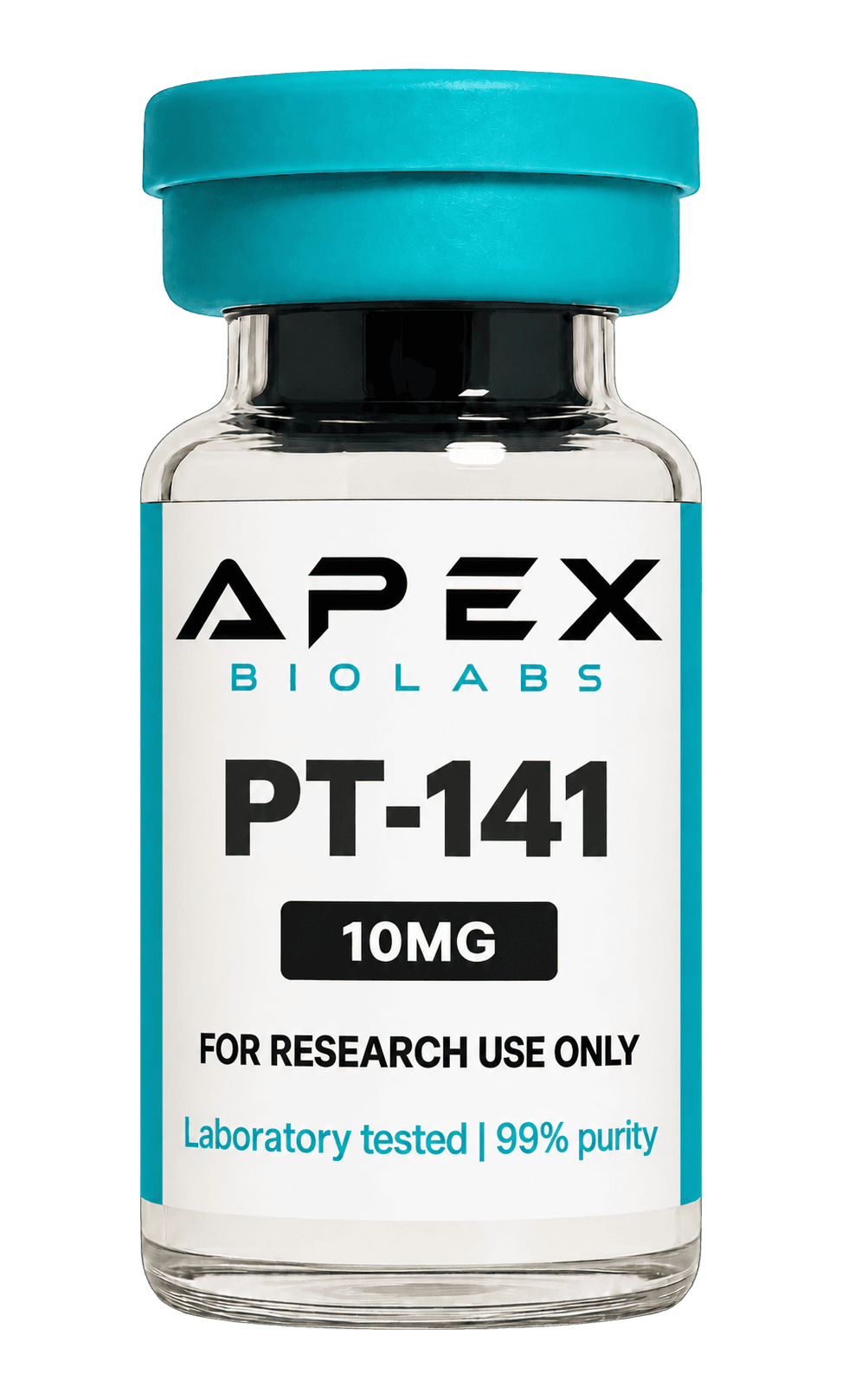
Research material
View PT-141
€34.98
Quick summary
- What it is: a synthetic cyclic 7-amino-acid peptide that activates melanocortin receptors in the brain, primarily MC4R.
- What makes it different: unlike most research peptides, it completed a full phase 3 clinical program and was approved by the FDA in 2019 under the brand name Vyleesi.
- What it is approved for: only for hypoactive sexual desire disorder (HSDD) in premenopausal women, in the United States. It is not approved in men or postmenopausal women.
- Safety profile: well documented from the trials. Notable are nausea, affecting 40% of participants, and a transient rise in blood pressure.
- In Europe and Spain: not authorized as a medicine.
What is PT-141?
PT-141 is the development code for bremelanotide. It is a cyclic heptapeptide: seven amino acids joined so that the chain closes on itself into a ring, making it more resistant to degradation than a linear peptide.
It belongs to the family of melanocortin analogs, molecules designed from alpha-melanocyte-stimulating hormone (α-MSH), which the body produces naturally.
The melanocortin receptors
There are five melanocortin receptors (MC1R to MC5R), each with distinct functions:
| Receptor | Where it acts primarily | Associated function |
|---|---|---|
| MC1R | Skin (melanocytes) | Pigmentation |
| MC3R and MC4R | Brain (hypothalamus) | Appetite, energy, and sexual behavior |
| MC2R | Adrenal gland | Cortisol production |
| MC5R | Exocrine glands | Glandular secretion |
Bremelanotide acts primarily on MC4R in the central nervous system. This is the key to its mechanism: it does not act on blood vessels like PDE5 inhibitors such as sildenafil, but rather on the brain pathways that regulate desire.
An accidental discovery: from tanning to desire
The origin of PT-141 is one of the most curious stories in modern pharmacology.
1980s, University of Arizona. A team of researchers including Mac Hadley was developing α-MSH analogs as sunless tanning agents, with the idea that induced pigmentation might protect against skin cancer. This is how Melanotan I and Melanotan II were born.
The unexpected finding. During initial Melanotan II testing, spontaneous erections were observed as a side effect. This opened a completely new line of research into sexual function.
From Melanotan II to bremelanotide. Palatin Technologies licensed Melanotan II, discontinued its development in 2000, and moved to work with bremelanotide, considered a metabolite of Melanotan II. The structural difference is minimal: a hydroxyl group instead of an amide group at the terminal end. In practice, it produces far less tanning than Melanotan II, although, as we will see, it can cause localized skin patches.
First phase: studies in men
The first clinical trials were conducted in men with erectile dysfunction.
- Diamond et al. (2004): in healthy volunteers and in men with erectile dysfunction who did not respond well to sildenafil, subcutaneous PT-141 produced significant erectile responses vs placebo and was well tolerated.
- Phase II intranasal formulation: Palatin tested a nasal spray in both men and women. In 2007 the FDA halted those trials due to blood pressure increases in participants, and the company abandoned the intranasal formulation in 2008.
After that setback, development shifted toward women with low sexual desire and the subcutaneous route.
The RECONNECT program: the main evidence
FDA approval was based on two identical phase 3 trials, randomized, double-blind, and placebo-controlled, known as RECONNECT, published by Kingsberg et al. in 2019.
Design:
- 1,267 premenopausal women with acquired, generalized hypoactive sexual desire disorder.
- 24 weeks of treatment, on-demand administration before sexual activity, vs placebo.
- Primary endpoints: change in the desire domain of the Female Sexual Function Index (FSFI-D) and distress associated with low desire (FSDS-DAO).
Results:
- The treated group improved in a statistically significant manner on desire and distress vs placebo.
- The effect size was small to moderate: in the pooled analysis, the improvement in the desire scale was 0.35 points more than with placebo.
- The number of satisfying sexual events barely changed: +0.7 per month with bremelanotide vs +0.2 with placebo.
Open-label extension: of the women who completed the controlled phase, 684 entered a 52-week extension without placebo, and 272 completed it. No new safety signals emerged.
The criticism: how results were reported
A reanalysis published in 2021 by Spielmans in The Journal of Sex Research noted that the main publication did not report a large proportion of the outcomes pre-specified in the trial protocols, and instead included secondary measures not listed in them. His meta-analysis using FDA submission data found similar results but questioned how the benefit was presented.
This is a good example of why, even with an approved drug, it is worth reading regulatory agency data, not just sponsored articles.
Adverse effect profile
Having gone through large trials, PT-141 has a much better characterized safety profile than most research peptides. According to the FDA label:
| Adverse effect | Bremelanotide | Placebo |
|---|---|---|
| Nausea | 40% | 1.3% |
| Flushing | ~20% | Low |
| Injection site reactions | ~13% | Low |
| Headache | ~11% | Low |
| Study discontinuation due to adverse effects | 18% | 2% |
Key points:
- Nausea: the most frequent effect, most intense with the first dose. It was the main cause of discontinuation.
- Blood pressure: produces a transient rise in blood pressure and a drop in heart rate after each dose. In a continuous monitoring study, daytime blood pressure rose by about 2 mmHg on average. It typically returns to baseline within 12 hours.
- Focal hyperpigmentation: dark patches localized on the face, gums, or chest. Occurred in 1% of participants with occasional use, but in a study with daily administration for 8 days it reached 38%. More common in darker skin tones and does not always resolve upon discontinuation. A reminder of its kinship with tanning peptides.
Regulatory status (updated October 2026)
United States: the FDA approved bremelanotide in June 2019 as Vyleesi (subcutaneous autoinjector), indicated only for acquired, generalized HSDD in premenopausal women. It was the second drug approved for this indication, after flibanserin. Currently marketed by Cosette Pharmaceuticals.
European Union and Spain: not authorized. According to industry sources, as of mid-2026 no marketing authorization application had been filed with the European Medicines Agency (EMA). Outside the United States, legal commercialization is limited to laboratory research.
Sport (WADA): bremelanotide is not expressly named on the 2026 Prohibited List. Athletes subject to testing should consult their anti-doping organization if in doubt.
PT-141 vs Melanotan II: not interchangeable
| PT-141 (bremelanotide) | Melanotan II | |
|---|---|---|
| Structure | Cyclic heptapeptide, hydroxyl terminal group | Cyclic heptapeptide, amide terminal group |
| Main receptor | MC4R (brain) | Non-selective: MC1R, MC3R, MC4R, MC5R |
| Tanning effect | Minimal, though may cause focal patches | Pronounced |
| Phase 3 trials | Yes (RECONNECT) | No |
| Approval | FDA 2019, premenopausal women with HSDD only | None in any country |
Material quality: what to check
- Lot-specific COA, not a generic one.
- Mass spectrometry (MS): confirms the expected mass and distinguishes bremelanotide from Melanotan II, which differ only in the terminal group.
- HPLC purity: indicates the proportion of the main peak, not the net peptide amount.
- Salt form: typically presented as acetate, which affects concentration calculations.
Laboratory handling
The manufacturer's specifications always take precedence. As general best practices:
- Lyophilized powder: store cold, protected from light and moisture.
- Before opening a cold vial: allow it to reach room temperature to avoid condensation.
- After reconstituting: record solvent, concentration, and date; store refrigerated.
- Long-term storage: aliquot to avoid repeated freeze-thaw cycles.
Conclusion
PT-141 is an unusual case among research peptides: it completed the full journey, from an accidental finding in a tanning program to a phase 3 trial with over 1,200 participants and FDA approval. That gives it something almost no other peptide has: solid efficacy and safety data in humans.
Those data also show its limits: a modest benefit, a high rate of nausea, blood pressure effects, and skin patches with frequent use, along with criticism of how results were published. Its approval is limited to a specific group (premenopausal women), and it is not authorized outside the United States.
For research, the most interesting open questions lie in the role of MC4R in other functions, such as appetite and energy, and in designing more selective analogs that preserve the central effect with fewer adverse effects.
Frequently asked questions
Are PT-141 and bremelanotide the same thing? Yes. PT-141 is the development code and bremelanotide is the generic name. The approved drug in the US is called Vyleesi.
Is it approved as a medicine? In the United States, yes, since 2019, but only for premenopausal women with hypoactive sexual desire disorder. In the European Union and Spain it is not authorized.
Does it work in men? There were phase II trials in men with erectile dysfunction showing positive results, but no phase 3 trials in men were ever conducted and it has no approval for that use.
How is it different from sildenafil (Viagra)? Sildenafil acts on blood vessels to facilitate erection. Bremelanotide acts on melanocortin receptors in the brain, on the pathways related to desire.
Why can it cause skin patches? Because it comes from the same family as tanning peptides and retains some activity at melanocyte receptors. The risk increases with frequent use and is greater in darker skin tones.
Is it banned in sport? It is not expressly named on the 2026 WADA Prohibited List. When in doubt, athletes should consult their anti-doping organization.
References
- Hadley ME, Dorr RT. Melanocortin peptide therapeutics: historical milestones, clinical studies and commercialization. Peptides. 2006;27(4):921-30.
- Diamond LE, et al. Evaluation of the safety, pharmacokinetics and pharmacodynamic effects of subcutaneously administered PT-141, a melanocortin receptor agonist, in healthy male subjects and in patients with an inadequate response to Viagra. Int J Impot Res. 2004;16(2):135-42. PubMed 14999221
- Kingsberg SA, et al. Bremelanotide for the treatment of hypoactive sexual desire disorder: two randomized phase 3 trials. Obstet Gynecol. 2019;134(5):899-908. PMC6819021
- Simon JA, et al. Long-term safety and efficacy of bremelanotide for hypoactive sexual desire disorder. Obstet Gynecol. 2019;134(5). PubMed 31599847
- Spielmans GI. Re-analyzing phase III bremelanotide trials for "hypoactive sexual desire disorder" in women. J Sex Res. 2021. DOI 10.1080/00224499.2021.1885601
- FDA. Drug Trials Snapshots: VYLEESI. fda.gov
- FDA. Vyleesi (bremelanotide injection) — prescribing information and multidisciplinary review, NDA 210557. accessdata.fda.gov
- LiverTox (NIH). Bremelanotide. NCBI Bookshelf NBK573221
- World Anti-Doping Agency (WADA). 2026 Prohibited List. wada-ama.org