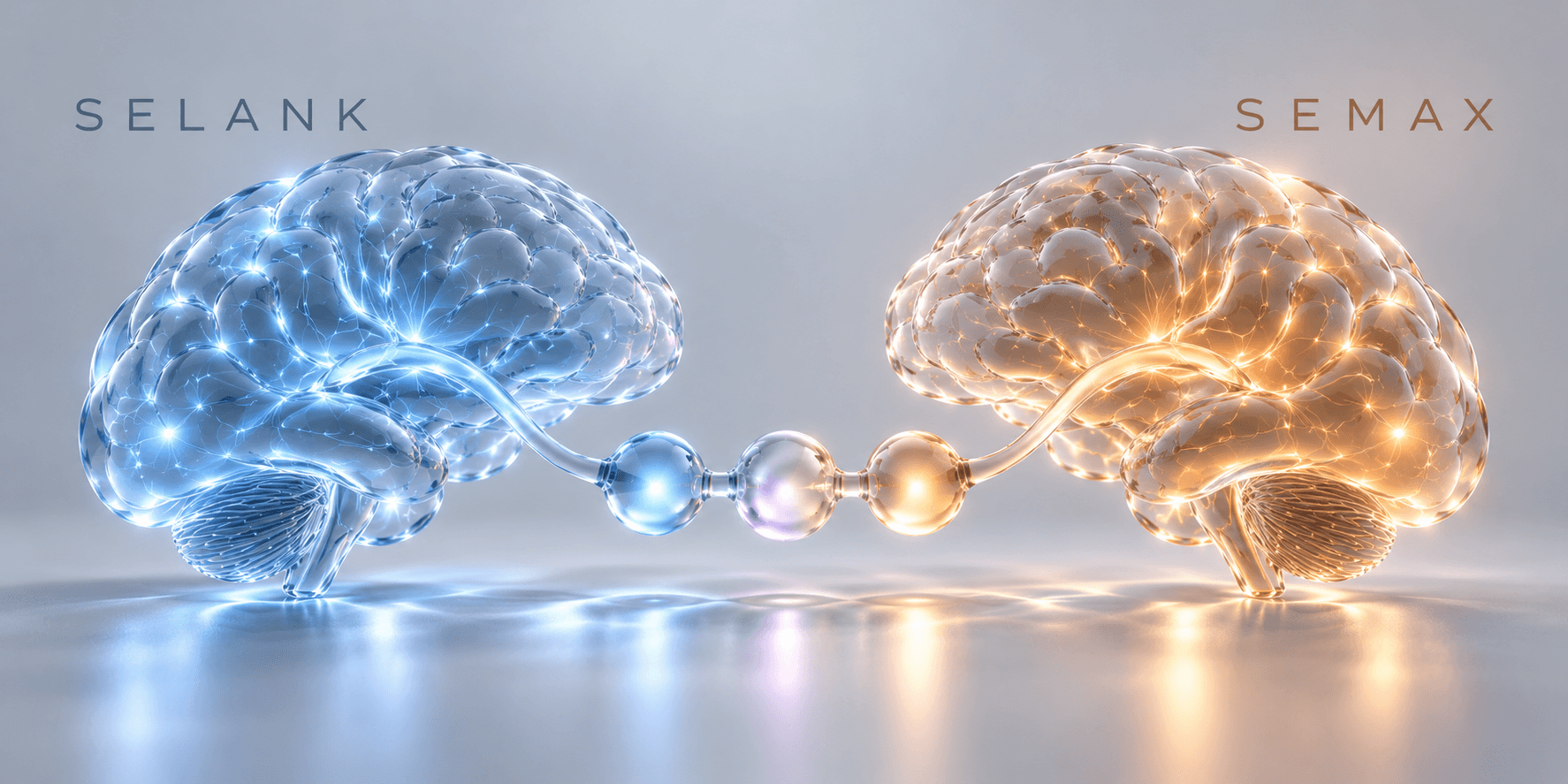
Selank and Semax: the Russian neurocognitive research peptides, in depth (Guide 2026)
Origin, mechanisms and evidence for Selank and Semax: BDNF, the GABA system, Russian trials in stroke and anxiety, differences between the two, and their regulatory status in 2026.
For research use only
The products and information on this page are intended exclusively for in vitro laboratory research and educational purposes. Not suitable for human consumption, diagnosis or therapeutic use. Studies cited are from third-party scientific literature and do not constitute medical advice.
Research material
View Selank
€39.98
Quick summary
- Selank and Semax are two synthetic 7-amino-acid peptides developed at the Institute of Molecular Genetics of the Russian Academy of Sciences.
- Semax is derived from a fragment of the ACTH hormone and has been studied mainly in ischemic stroke and in the production of BDNF, a key protein for neurons.
- Selank is derived from an immune peptide called tuftsin and has been studied mainly as an anxiolytic.
- Both are registered as medicines in Russia, but not approved in the European Union or the United States.
- Their main limitation: almost all clinical evidence comes from Russian trials, with virtually no independent replication in other countries.
A shared origin
Selank and Semax are "siblings." Both were developed at the same Moscow institute, under the direction of Academician Nikolai Myasoyedov's group, and share a design principle:
- Start from a natural peptide with interesting biological activity.
- Add the sequence Pro-Gly-Pro (PGP) to the end of the chain — this protects the molecule from enzymes and prolongs its action.
| Semax | Selank | |
|---|---|---|
| Sequence | Met-Glu-His-Phe-Pro-Gly-Pro (MEHFPGP) | Thr-Lys-Pro-Arg-Pro-Gly-Pro (TKPRPGP) |
| Parent peptide | ACTH fragment 4–7 | Tuftsin (antibody fragment) |
| Stabilizing tail | PGP | PGP |
| Main area of study | Neuroprotection, stroke, cognition | Anxiety, mood |
| Route studied in Russia | Intranasal | Intranasal |
| Registration in Russia | Yes, since the 1990s | Yes, since 2009 |
PART 1: SEMAX
What is Semax?
Semax is an analogue of the ACTH(4-10) fragment. ACTH (adrenocorticotropic hormone) is a hormone that stimulates cortisol production. Since the 1970s it was known that some short fragments of ACTH had effects on learning and memory without the hormonal activity of the full molecule.
Semax takes amino acids 4 to 7 of ACTH and adds the PGP tail. The result is a molecule with effects on the nervous system, but without a relevant effect on cortisol.
Mechanism: the role of BDNF
BDNF (brain-derived neurotrophic factor) is a protein that promotes neuron survival, the formation of new connections, and learning processes. It is one of the most studied mechanisms of Semax.
Dolotov et al. (2006, Brain Research): in rats, a single intranasal administration of Semax produced, in the hippocampus (a key zone for memory):
- a 1.4-fold increase in BDNF protein;
- a 1.6-fold increase in activation of its receptor, TrkB;
- a 3-fold increase in BDNF mRNA.
Treated animals also showed better performance in a learning test.
Other animal findings:
- The same group identified specific binding sites for Semax in the rat brain, pointing to a concrete biological target.
- In models of cerebral ischemia (reduced blood supply), Semax activated the expression of several neurotrophic factor genes (BDNF, NGF, and their receptors) in the hours and days following the event.
- Effects on the dopamine and serotonin systems have been described in rodents.
Human evidence: the Russian stroke trials
Most of the clinical evidence for Semax comes from the group of neurologist Evgeny Gusev in Russia:
| Study | Population | Reported results |
|---|---|---|
| Gusev et al., 1997 | 30 patients with acute ischemic stroke vs. 80 controls with conventional treatment | Favorable clinical and electrophysiological signals in the treated group |
| Gusev et al., 2005 | 187 patients with chronic cerebrovascular insufficiency | Clinical improvement and good tolerability, including in elderly patients |
| Gusev et al., 2018 | 110 patients in rehabilitation after ischemic stroke | Increase in blood BDNF, associated with better functional recovery |
Status in Russia: Semax is registered as a medicine for stroke, transient ischemic attack, and some optic nerve disorders, and is listed on Russia's list of vital and essential medicines.
Limitations
- Virtually no trials outside Russia and post-Soviet countries.
- Much of the research was published in Russian, in journals with limited international reach, making independent assessment difficult.
- Several trials do not meet current design standards (randomization, double-blinding, pre-registration).
- No Western clinical guideline recommends it.
In their 2026 evaluation, FDA staff concluded that the criteria weighed against allowing its use in compounding pharmacies, precisely due to the limitations of the evidence.
PART 2: SELANK
What is Selank?
Selank is an analogue of tuftsin, a natural peptide of just 4 amino acids (Thr-Lys-Pro-Arg) released from IgG antibodies and involved in immune system regulation.
By adding the PGP tail, Russian researchers obtained a more stable molecule that, in addition to retaining immune effects, showed anxiolytic effects in animal models.
Mechanism: several systems at once
Selank appears to act on several systems, with none alone explaining all its effects:
- GABA system: GABA is the brain's main "calming" neurotransmitter. A 2018 study (Vyunova et al.) found that Selank enhances GABA binding to its receptor, but without acting at the same site as benzodiazepines (like diazepam). This is an allosteric modulation mechanism.
- Enkephalins: Selank inhibits enzymes that degrade enkephalins, natural peptides related to stress and pain regulation. In a clinical trial, increased enkephalin half-life in blood correlated with reduced anxiety.
- Gene expression: in rats, Selank modified the expression of dozens of genes related to neurotransmission within one hour.
- Immune system: inherited from tuftsin, with effects on cytokine balance (immune signaling molecules).
Human evidence
| Study | Design | Population | Reported results |
|---|---|---|---|
| Zozulia et al., 2008 | Comparative vs. medazepam (a benzodiazepine) | 62 patients with generalized anxiety and neurasthenia (30 Selank, 32 medazepam) | Anxiolytic effect similar to medazepam, with additional effect against fatigue |
| Medvedev et al. | Comparative vs. phenazepam (another benzodiazepine) | 60 patients with anxiety disorders | Anxiolytic effect and mild nootropic effects |
What the authors highlight: unlike benzodiazepines, Selank did not produce sedation in these studies. Russian researchers also describe an absence of dependence, although the studies were too short and small to assess this conclusively.
Status in Russia: registered as a medicine for generalized anxiety disorder and neurasthenia.
Limitations
These are the same as for Semax, and somewhat more pronounced:
- Small samples (around 60 patients per study).
- Comparison with another drug rather than placebo, making it difficult to measure the true effect.
- No independent replication outside Russia.
- Publications mostly in Russian.
Selank vs Semax: what sets them apart?
| Semax | Selank | |
|---|---|---|
| Main studied profile | Cognitive activator and neuroprotector | Anxiolytic and stabilizer |
| Most studied mechanism | Increase in BDNF and neurotrophic factors | Modulation of GABA system and enkephalins |
| Main clinical evidence | Ischemic stroke | Generalized anxiety |
| Largest human trial | 187 patients | 62 patients |
| FDA review (2026) | Evaluated; advisory committee voted in favor in July 2026 | Not included in that review |
In the Russian literature they are often described as complementary: Semax with a more "activating" profile and Selank with a more "calming" one.
Safety: what is known and what is not
What Russian studies report:
- Generally good tolerability, with no serious adverse effects described.
- With Selank, absence of sedation and memory impairment, unlike benzodiazepines.
What is not known:
- The long-term safety profile, with quality data.
- Interactions with other drugs acting on the nervous system.
- Effects in unstudied populations.
- For Semax, since it increases neuronal growth factors, its long-term profile deserves rigorous study, as with any modulator of these pathways.
The absence of reported adverse effects in small studies is not equivalent to demonstrating safety.
Regulatory status (updated October 2026)
Russia and some post-Soviet countries: both are registered as medicines.
European Union and EU member states: neither is authorized as a medicine. Their legal sale is limited to laboratory research.
United States (FDA):
- Neither is approved as a medicine.
- Semax: on July 24, 2026, the FDA's Pharmacy Compounding Advisory Committee voted in favor of including it on the list of substances permitted in compounding pharmacies, contrary to FDA staff's recommendation. The evaluated uses were cerebral ischemia, migraine, and trigeminal neuralgia. The vote is not binding, and the FDA had not published a final decision as of late October 2026.
- Selank: was not part of that review.
Sport (WADA): neither appears by name on the 2026 Prohibited List. Their status is not entirely clear, since they are approved in Russia but not in most countries. Athletes subject to anti-doping controls should consult their anti-doping organization.
Material quality: what to check
- Lot-specific COA, with purity by HPLC and mass spectrometry.
- Expected mass: Semax and Selank have different masses, so mass spectrometry can confirm that the vial contains the correct peptide.
- Similarly named variants: modified versions circulate, such as "N-acetyl Semax" or "N-acetyl Selank amidate." These are different molecules, with additional chemical modifications, and have almost no published studies. The data in this article refer to the original forms.
Laboratory handling
The manufacturer's specification takes precedence. As general good practice:
- Lyophilized powder: store cold, protected from light and moisture.
- Before opening a cold vial: let it reach room temperature to avoid condensation.
- After reconstitution: record solvent, concentration, and date; store refrigerated.
- Long-term storage: aliquot to avoid repeated freeze-thaw cycles.
Conclusion
Selank and Semax are a singular case: medicines registered in one country and research compounds in the rest of the world. Behind them lie decades of work from the same institute, interesting and well-described mechanisms in animals (BDNF for Semax, the GABA system and enkephalins for Selank), and clinical trials that report favorable results.
But that evidence has a clear limit: it comes almost entirely from Russian groups, with small studies published mostly in Russian and without independent replication. The 2026 FDA review reflected this: staff considered the evidence insufficient, though the advisory committee voted in favor of Semax.
The most interesting open questions are precisely the missing ones: placebo-controlled trials, outside Russia, with long-term follow-up.
Frequently asked questions
What is the difference between Selank and Semax? Semax is derived from a fragment of the ACTH hormone and has been studied mainly in neuroprotection, stroke, and cognition, with BDNF as the primary mechanism. Selank is derived from tuftsin, an immune peptide, and has been studied mainly as an anxiolytic, with effects on the GABA system.
Are they approved as medicines? Yes in Russia, where both are registered. Not in the European Union or the United States.
Why do they have the Pro-Gly-Pro sequence at the end? It is a stabilizing tail that Russian researchers added to both peptides to protect them from enzymes and prolong their action.
What is BDNF? It is brain-derived neurotrophic factor, a protein that promotes neuron survival and the formation of new connections. It is one of the most studied mechanisms of Semax.
Are they the same as N-acetyl Semax or N-acetyl Selank? No. These are chemically modified variants with very few published studies. The data in this guide refer to the original forms.
Is their safety well studied? Russian studies describe good tolerability, but they are small and short in duration. There are no quality data on long-term safety.
References
- Dolotov OV, Karpenko EA, Inozemtseva LS, et al. Semax, an analog of ACTH(4-10) with cognitive effects, regulates BDNF and trkB expression in the rat hippocampus. Brain Res. 2006;1117(1):54-60. PubMed 16996037
- Dolotov OV, Karpenko EA, Seredenina TS, et al. Semax, an analogue of adrenocorticotropin (4-10), binds specifically and increases levels of brain-derived neurotrophic factor protein in rat basal forebrain. J Neurochem. 2006.
- Study on the expression of neurotrophin genes and their receptors in rat brain after focal ischemia and Semax treatment. Cell Mol Neurobiol. 2009. DOI 10.1007/s10571-009-9432-0
- Gusev EI, et al. Effectiveness of Semax in acute ischemic stroke (clinical and electrophysiological study). Zh Nevrol Psikhiatr Im S S Korsakova. 1997.
- Gusev EI, Martynov MY, Kostenko EV, Petrova LV, Bobyreva SN. The efficacy of semax in the treatment of patients at different stages of ischemic stroke. Zh Nevrol Psikhiatr Im S S Korsakova. 2018. DOI 10.17116/jnevro20181183261-68
- Zozulia AA, Neznamov GG, Siuniakov TS, et al. Efficacy and possible mechanisms of action of a new peptide anxiolytic selank in the therapy of generalized anxiety disorders and neurasthenia. Zh Nevrol Psikhiatr Im S S Korsakova. 2008. PubMed 19002092
- Medvedev VE, et al. A comparison of the anxiolytic effect and tolerability of selank and phenazepam in the treatment of anxiety disorders.
- Vyunova TV, et al. Peptide-based anxiolytics: the molecular aspects of heptapeptide selank biological activity. 2018. PubMed 29905936
- FDA. Briefing document: Semax-related bulk drug substances. Pharmacy Compounding Advisory Committee, July 23–24, 2026. fda.gov
- McDermott Will & Schulte. PCAC backs majority of peptides in two-day public meeting. July 2026. mcdermottlaw.com
- World Anti-Doping Agency (WADA). 2026 Prohibited List. wada-ama.org