
TB-500 and Thymosin Beta-4: what the science says and what's really in the vial (Guide 2026)
Research guide on TB-500 and thymosin beta-4: the difference between the full protein and the fragment, wound, cardiac and corneal studies, human trials, and regulatory status in 2026.
For research use only
The products and information on this page are intended exclusively for in vitro laboratory research and educational purposes. Not suitable for human consumption, diagnosis or therapeutic use. Studies cited are from third-party scientific literature and do not constitute medical advice.
Research material
View TB-500
€34.98
Quick summary
- Thymosin beta-4 (Tβ4): a natural 43-amino-acid protein, present in almost all cells of the body. This is the molecule studied in the scientific literature.
- TB-500: a trade name with no official definition. Forensic analysis identified it as a synthetic fragment of only 7 amino acids of Tβ4, although some suppliers sell the full protein under that name.
- Evidence: strong in animal models (wounds, heart, cornea) and with human trials, but almost all with the full protein, not the fragment.
- Regulation (October 2026): not approved as a medicine in any country and expressly prohibited by WADA.
The starting point: what do we mean by "TB-500"?
This is the most important aspect of this peptide and the one almost no website explains well. There are two distinct molecules circulating under similar names:
| Thymosin Beta-4 (Tβ4) | TB-500 (fragment) | |
|---|---|---|
| Size | 43 amino acids | 7 amino acids |
| Sequence | Full protein | Ac-LKKTETQ (positions 17–23 of Tβ4, acetylated) |
| Approximate molecular weight | ~4,960 Da | ~889 Da |
| Origin | Natural, present in almost all cells | Synthetic |
| Published studies | Hundreds, including clinical trials | Very few, almost all analytical |
How it was discovered what TB-500 was
TB-500 originated in the world of horse racing, marketed as a veterinary product for tendon injuries. In 2012, the anti-doping laboratory at Ghent University (Belgium) analyzed vials seized by Belgian customs and published that its active component was the acetylated fragment Ac-LKKTETQ, not the full protein. That same year, another group developed methods to detect it in equine urine and plasma.
Why this matters
The vast majority of studies cited when discussing "TB-500" (wound healing, heart, cornea) were done with full Tβ4. The fragment LKKTETQ contains the actin-binding region, considered key for cell migration, but the full protein has other regions with their own functions that the fragment does not include.
In practice: before designing an experiment or interpreting results, confirm from the certificate of analysis which of the two molecules the vial contains. A molecular weight of ~889 Da corresponds to the fragment; ~4,960 Da corresponds to the full protein.
What is thymosin beta-4?
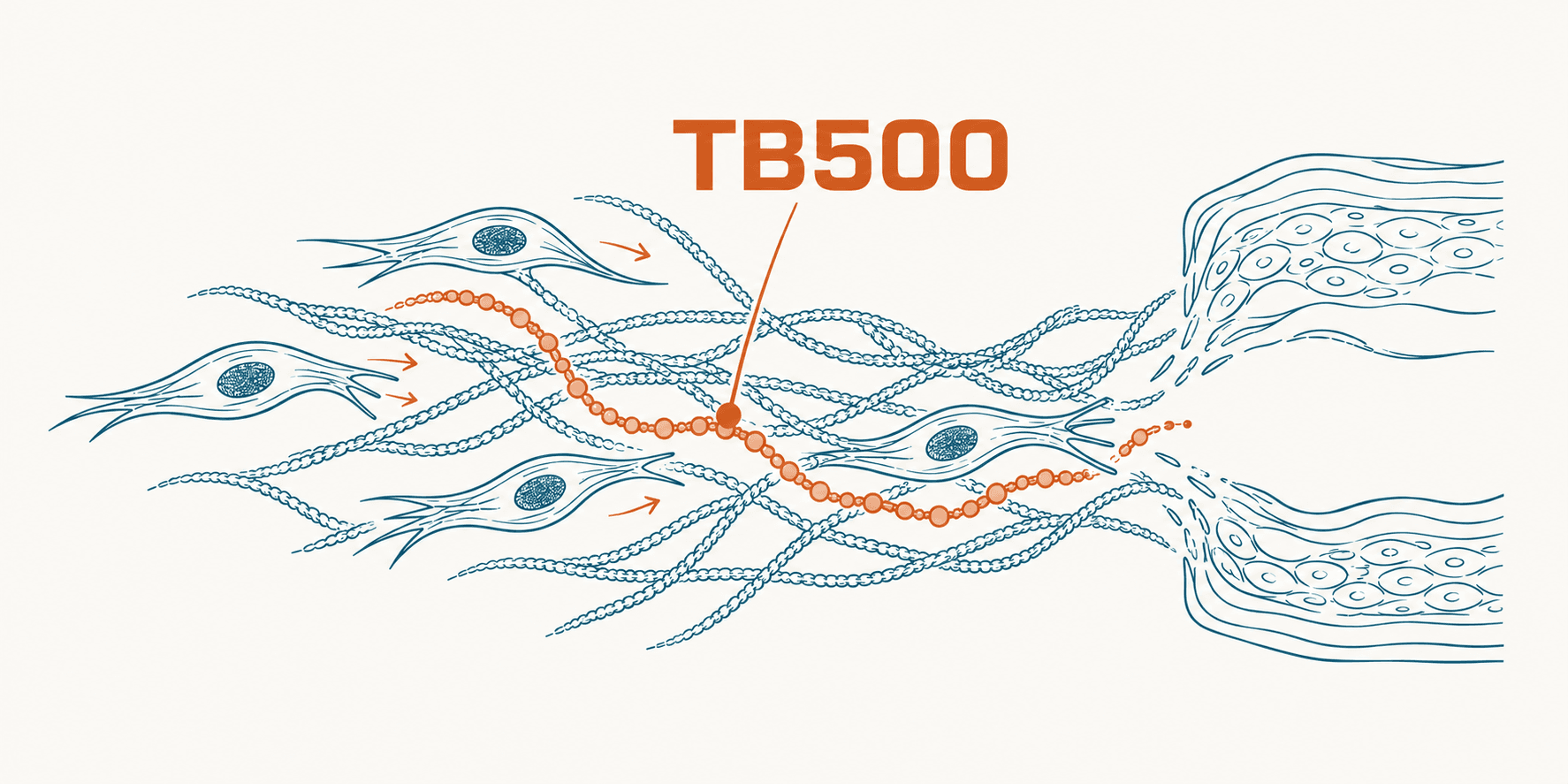
Tβ4 is the main actin-sequestering protein in mammalian cells. Actin is the protein that forms the cell's internal "skeleton," allowing it to change shape and move. Tβ4 binds free actin (G-actin) and regulates how much is available to form filaments.
That is why it is involved in processes dependent on cell movement: migration of cells toward a wound, blood vessel formation, and tissue reorganization. Platelets also release it at the site of injury, supporting the idea that it participates in repair.
Studied mechanisms
1. Cell migration and wound healing
The foundational work is Malinda et al. (1999), in rats with full-thickness skin wounds. Tβ4, applied both topically and systemically, increased re-epithelialization by 42% at 4 days and up to 61% at 7 days vs saline control. More wound contraction, collagen deposition, and new vessels were also observed. In culture, it stimulated keratinocyte migration at very small amounts.
2. Tissue remodeling
Philp et al. (2006) observed that Tβ4 increased expression of several matrix metalloproteinases (MMPs) in wounds — enzymes that degrade and remodel the damaged tissue matrix. This effect was associated with the central actin-binding region, the same one the TB-500 fragment contains.
3. Which part of the molecule does what?
Sosne et al. (2010) studied short Tβ4 fragments and proposed that different activities are distributed across different regions: some related to migration and healing, others to cellular protection and anti-inflammatory response. This is the scientific basis for studying fragments, but also the reason why a fragment does not necessarily reproduce all the effects of the full protein.
4. Cardiac repair
Two studies published in Nature made Tβ4 a molecule of interest in cardiology:
- Bock-Marquette et al. (2004): in mice with induced myocardial infarction, Tβ4 improved cardiac muscle cell survival and heart function. The identified mechanism was the formation of a complex with PINCH and ILK proteins, activating Akt, a key enzyme for cell survival.
- Smart et al. (2007): in adult mice, Tβ4 mobilized epicardial progenitor cells (from the heart's outer layer) and favored new vessel formation.
Reminder: these studies were done with full Tβ4 and in mice. No equivalent published data exists with the TB-500 fragment.
Key studies in animal models
| Study | Molecule | Model | What was found |
|---|---|---|---|
| Malinda et al., 1999 | Full Tβ4 | Rat with skin wound | More re-epithelialization, contraction, collagen, and vessels vs control |
| Sosne et al., 2002 | Full Tβ4 | Mouse with chemical corneal burn | Faster corneal healing and less inflammation |
| Bock-Marquette et al., 2004 | Full Tβ4 | Mouse with myocardial infarction | Better cardiomyocyte survival and cardiac function, via PINCH-ILK-Akt |
| Philp et al., 2006 | Tβ4 and central region | Animal wound model | Increased metalloproteinases involved in remodeling |
| Smart et al., 2007 | Full Tβ4 | Adult mouse | Epicardial progenitor mobilization and new vessels |
| Esposito et al., 2012 | TB-500 fragment | Chemical analysis of seized vials | Identification of Ac-LKKTETQ as active component |
What exists in humans?
Here Tβ4 has more clinical evidence than most research peptides, thanks to RegeneRx and its partners. But again: all with the full protein.
| Program | Design | Population | What is known |
|---|---|---|---|
| Ruff et al., 2010 (RGN-352) | Phase I, randomized, placebo-controlled, intravenous | Healthy volunteers | Well tolerated at escalating doses, no dose-limiting toxicity |
| Phase I in China (recombinant Tβ4, NL005) | Phase I, double-blind, single and repeated doses, intravenous | 54 + 30 healthy volunteers | Well tolerated, no serious adverse events |
| ARISE-1, 2 and 3 (RGN-259, eye drops) | Phase 2b/3 and phase 3, placebo-controlled | Dry eye; ARISE-3 included 700 patients, ~1,500 total | Company reported positive results in pooled analysis; primary endpoints were not consistently met in each trial individually |
| SEER-1 (RGN-259, eye drops) | Phase 3, randomized, double-blind | Neurotrophic keratopathy (rare corneal disease) | Registry shows early termination due to "business decision" |
What does not exist: no published clinical trial with the TB-500 fragment in humans, nor Tβ4 trials for musculoskeletal injuries.
Safety: the cancer question
Tβ4 promotes cell migration and vessel formation — two processes tumors also use to grow and spread. And there are data linking them:
- Several studies have observed elevated Tβ4 levels in metastatic tumors, for example in colorectal, breast, and gastric cancer, often alongside poor prognosis markers.
- In culture, colon cancer cells engineered to produce more Tβ4 became more invasive.
- A 2012 review proposed Tβ4 as a potential therapeutic target against metastasis — meaning something to block in the context of cancer.
How to interpret this: these are data about Tβ4 produced by tumor cells themselves, not about external peptide administration. Phase I trials showed no short-term safety issues, but there are no long-term studies that rule out risks with prolonged exposure. This remains the main open question about this molecule.
Regulatory status (updated October 2026)
Sport (WADA): the Prohibited List expressly includes "thymosin-β4 and its derivatives, e.g. TB-500" under category S2 (peptide hormones, growth factors, and related substances), prohibited at all times.
United States (FDA):
- Neither Tβ4 nor TB-500 are approved as drugs.
- On July 23, 2026, the FDA's Pharmacy Compounding Advisory Committee voted 8 in favor, 6 against, and 1 abstention to recommend TB-500 for the list of substances permitted in compounding pharmacies, contrary to the FDA's own staff's position.
- The vote is not binding. As of late October 2026, the FDA had not published a final decision.
European Union and Spain: no authorized medicine contains Tβ4 or TB-500. Legal commercialization is limited to laboratory research.
Material quality: what to check
- Molecule identity: this is first. Check in the COA whether it is the fragment (~889 Da) or the full protein (~4,960 Da). If the certificate is unclear, ask the supplier.
- Mass spectrometry (MS): confirms the mass and, for the fragment, the N-terminal acetylation.
- HPLC purity: indicates the proportion of the main peak, not the net peptide amount.
- Lot-specific COA and, if possible, independent laboratory verification.
Laboratory handling
The manufacturer's specifications always take precedence. As general best practices:
- Lyophilized powder: store cold, protected from light and moisture.
- Before opening a cold vial: allow it to reach room temperature to avoid condensation.
- After reconstituting: record solvent, concentration, and date; store refrigerated.
- Long-term storage: aliquot to avoid repeated freeze-thaw cycles.
Conclusion
Thymosin beta-4 is one of the best-studied repair proteins: consistent results in wounds, cornea, and heart in animals, a well-described mechanism (actin, PINCH-ILK-Akt), and clinical trials showing good short-term tolerability.
But "TB-500" is not the same as Tβ4. The synthetic fragment identified by anti-doping labs shares the actin-binding region but lacks other parts of the protein, and has virtually no studies of its own. Add to this the open question about its relationship with tumor progression.
For researchers, the first step is always the same: know exactly what molecule is in the vial and use studies done with that same molecule as reference.
Frequently asked questions
Are TB-500 and thymosin beta-4 the same thing? No. Tβ4 is a natural 43-amino-acid protein. The TB-500 identified by anti-doping labs is a synthetic 7-amino-acid fragment (Ac-LKKTETQ). Some suppliers sell the full protein under the name TB-500, which is why the certificate of analysis must be checked.
Do the wound healing and cardiac studies apply to TB-500? They were done with full Tβ4. The fragment contains an important region for cell migration, but it cannot be assumed to reproduce all the effects of the full protein.
Is it approved as a medicine? No, in any country. In the US, an FDA advisory committee recommended in July 2026 allowing its use in compounding pharmacies, but the FDA has not made a final decision.
Is it banned in sport? Yes. WADA expressly names it under category S2, together with thymosin beta-4 and its derivatives.
Can it promote cancer? There are no data showing that administering Tβ4 causes cancer. There are studies associating high Tβ4 levels produced by tumor cells themselves with greater metastatic capacity. Long-term studies are lacking to resolve the question.
References
- Malinda KM, Sidhu GS, Mani H, et al. Thymosin beta4 accelerates wound healing. J Invest Dermatol. 1999;113(3):364-8. PubMed 10469335
- Sosne G, Szliter EA, Barrett R, et al. Thymosin beta 4 promotes corneal wound healing and decreases inflammation in vivo following alkali injury. Exp Eye Res. 2002.
- Bock-Marquette I, Saxena A, White MD, DiMaio JM, Srivastava D. Thymosin beta4 activates integrin-linked kinase and promotes cardiac cell migration, survival and cardiac repair. Nature. 2004;432:466-72. PubMed 15565145
- Wang WS, et al. Overexpression of the thymosin beta-4 gene is associated with increased invasion of SW480 colon carcinoma cells and the distant metastasis of human colorectal carcinoma. Oncogene. 2004. DOI 10.1038/sj.onc.1207888
- Philp D, et al. Thymosin beta4 promotes matrix metalloproteinase expression during wound repair. J Cell Physiol. 2006. PubMed 16607611
- Smart N, Risebro CA, Melville AA, et al. Thymosin beta4 induces adult epicardial progenitor mobilization and neovascularization. Nature. 2007;445:177-82. PubMed 17108969
- Sosne G, Qiu P, Goldstein AL, Wheater M. Biological activities of thymosin beta4 defined by active sites in short peptide sequences. FASEB J. 2010;24(7):2144-51. PubMed 20179146
- Ruff D, Crockford D, Girardi G, Zhang Y. A randomized, placebo-controlled, single and multiple dose study of intravenous thymosin beta4 in healthy volunteers. Ann N Y Acad Sci. 2010;1194:223-9. PubMed 20536472
- Esposito S, Deventer K, Goeman J, Van der Eycken J, Van Eenoo P. Synthesis and characterization of the N-terminal acetylated 17-23 fragment of thymosin beta 4 identified in TB-500, a product suspected to possess doping potential. Drug Test Anal. 2012. PubMed 22962027
- Ho EN, et al. Doping control analysis of TB-500, a synthetic version of an active region of thymosin β4, in equine urine and plasma by liquid chromatography-mass spectrometry. J Chromatogr A. 2012. PubMed 23084823
- Thymosin β4: a potential molecular target for tumor therapy. Crit Rev Eukaryot Gene Expr. 2012;22(2):109-16. PubMed 22856429
- A first-in-human, randomized, double-blind, single- and multiple-dose, phase I study of recombinant human thymosin β4 in healthy Chinese volunteers. J Cell Mol Med. 2021. PMC8419156
- ClinicalTrials.gov. NCT02600429 — SEER-1: RGN-259 ophthalmic solution for neurotrophic keratopathy. View record
- ReGenTree / RegeneRx. ARISE-3 results and pooled ARISE-1, 2 and 3 analysis (press release, 2021). View release
- World Anti-Doping Agency (WADA). 2026 Prohibited List, category S2. wada-ama.org
- FDA. Pharmacy Compounding Advisory Committee, meeting of July 23–24, 2026. fda.gov